
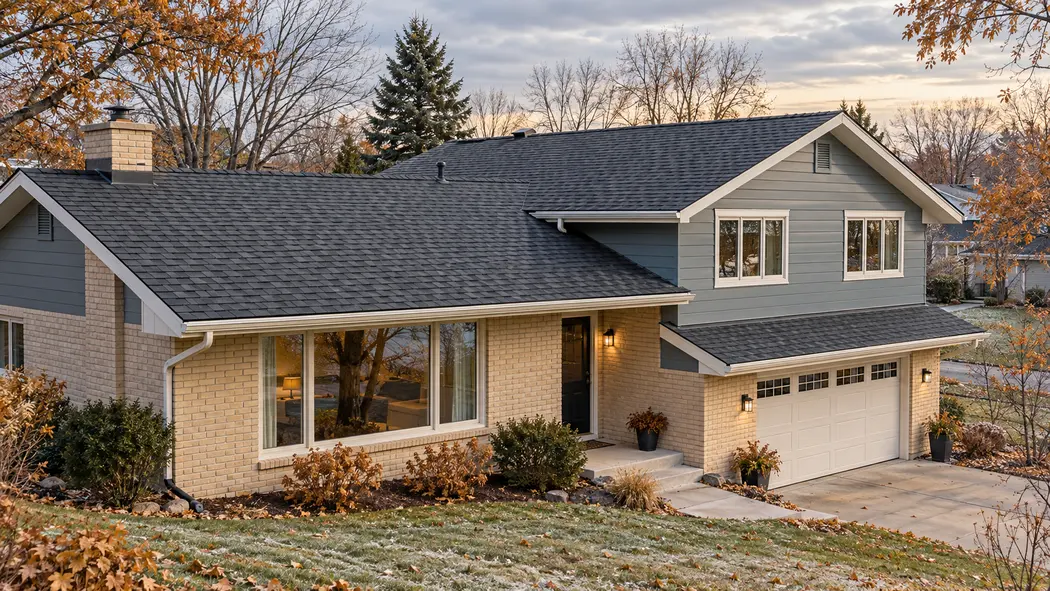
Twin Cities ice dam prevention begins long before the first major snowfall. For homeowners in Minneapolis, St. Paul, Bloomington, Maple Grove, and surrounding Minnesota communities, fall is an important time to identify conditions that could contribute to ice buildup along roof edges during winter.
Ice dams can cause serious moisture problems when melting snow refreezes near colder roof eaves, creating a barrier that prevents additional meltwater from draining properly. Water may then collect behind the ice and enter vulnerable parts of the roofing system.
Although ice dams become visible during winter, many contributing factors already exist during fall. Unsealed attic openings, inadequate insulation, and uneven heat loss can affect roof surface temperatures once snow arrives.
The good news is that homeowners can take practical steps before winter to reduce these risks.
However, not every roofing issue causes ice dams, and cleaning gutters alone will not prevent them. Understanding how heat moves through the home is especially important.
In this guide, Bold North Roofing & Contracting explains how ice dams form, what Twin Cities homeowners should check during fall, and when a professional Minnesota roof inspection may be helpful.
How Can Twin Cities Homeowners Help Prevent Ice Dams Before Winter?
The most effective long-term approach to ice dam prevention is to reduce unwanted heat transfer from living spaces into the attic and roofing system.
Homeowners should consider:
Identifying and sealing attic air leaks
Evaluating attic insulation levels and coverage
Checking that existing attic ventilation works as designed
Ensuring bathroom and kitchen exhaust ducts terminate outdoors
Inspecting roof flashing and vulnerable connections
Clearing heavy leaf debris from gutters and roof valleys
Reviewing previous winter ice dam locations
Investigating attic moisture and ceiling stains
Scheduling a home energy assessment when recurring ice dams are present
Addressing confirmed roof damage before snowfall
Important: Air sealing and appropriate insulation are among the most important long-term measures. Gutter maintenance and roof inspections support overall roof performance but do not, by themselves, correct the heat loss that commonly causes ice dams.
What Is an Ice Dam, and Why Does It Form on Minnesota Roofs?
An ice dam is a ridge of ice that develops near the edge of a snow-covered roof and restricts the normal drainage of meltwater.
Ice dam formation involves differences in roof surface temperature.
When heat escapes from the home, it can warm portions of the roof beneath accumulated snow. The snow begins melting even when outdoor air temperatures remain below freezing.
As the meltwater travels down toward a colder roof edge, it can freeze again.
Repeated melting and refreezing can create an ice barrier.
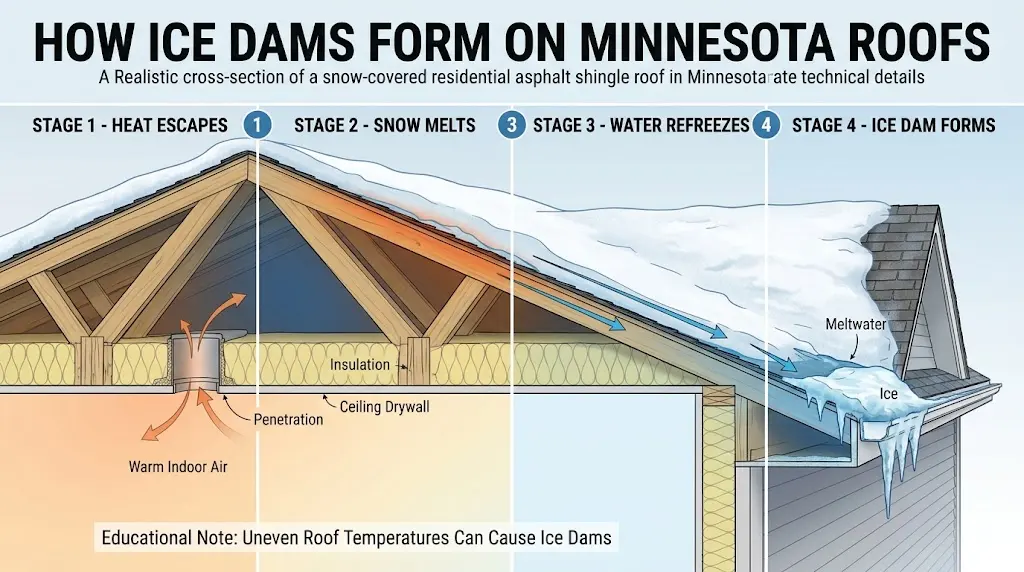
The Four Stages of Ice Dam Formation
1. Heat escapes into the attic.
Warm indoor air moves through unsealed ceiling gaps or heat passes through insufficiently insulated areas.
2. Snow melts on warmer roof sections.
Heat reaching the roof deck may raise the temperature of the roofing surface beneath the snow.
3. Meltwater reaches colder eaves.
Water travels downslope until it reaches a roof section that remains below freezing.
4. Ice accumulates and restricts drainage.
As ice builds up, additional meltwater may collect behind the dam and potentially enter vulnerable roofing connections.
The University of Minnesota Extension’s guide to dealing with and preventing ice dams identifies uneven roof temperatures, snow cover, outdoor conditions, and heat loss as important factors.
Are Ice Dams Caused by Freezing Temperatures Alone?
No.
Cold weather alone does not create an ice dam. Snow cover and roof temperature differences are important parts of the process.
A properly functioning roof assembly can reduce unwanted heat transfer, but no single improvement guarantees that ice dams will never occur.
01Understand How Ice Dams Form on Minnesota Roofs
An ice dam is a ridge of ice that forms near the lower edge of a roof and interferes with the normal drainage of melting snow.
It generally develops when the roof surface is warm enough to melt snow in one area while the eaves remain cold enough for the water to freeze.
The University of Minnesota Extension’s ice dam prevention guide explains the relationship between roof temperatures, snow cover, and unwanted heat loss.
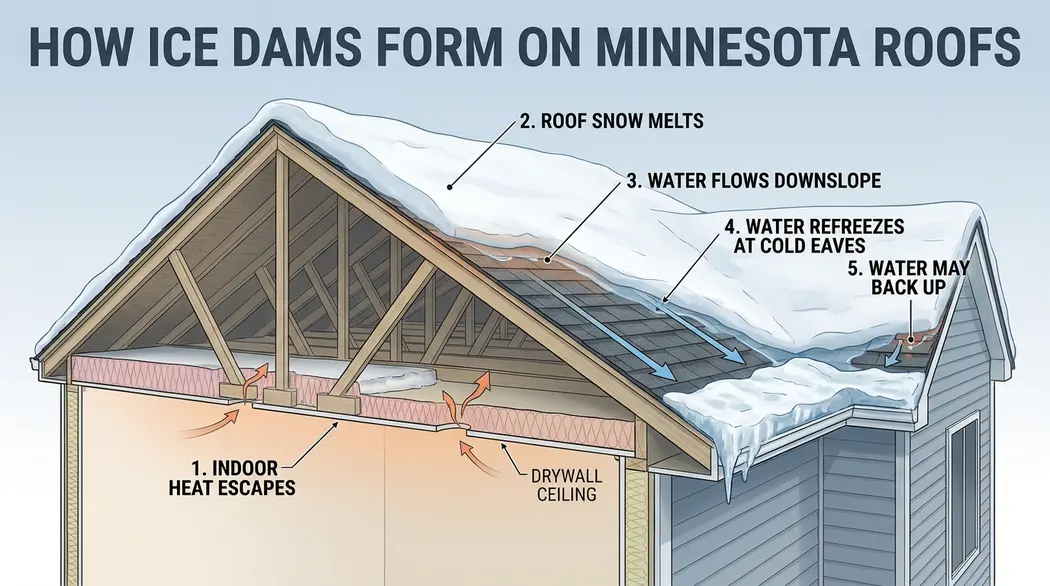
The Ice Dam Formation Process
Stage 1: Indoor heat escapes upward.
Warm indoor air passes through openings in the ceiling or other parts of the building assembly and enters the attic.
Stage 2: The roof deck becomes warmer.
Heat reaching the roof assembly can warm some portions of the roof beneath accumulated snow.
Stage 3: Snow begins melting.
Water forms beneath the snowpack and moves downward along the roof slope.
Stage 4: Water reaches colder eaves.
Because roof edges often extend beyond the heated living space, they may remain colder than the upper roof.
Stage 5: Water refreezes.
Ice accumulates near the roof edge and may create a barrier that prevents additional meltwater from draining normally.
Stage 6: Water collects behind the ice.
If water backs up far enough, it may reach vulnerable shingle overlaps or roofing connections and enter the structure.
Does an Ice Dam Mean the Roof Was Installed Incorrectly?
Not necessarily.
Ice dams can occur on homes with otherwise functional roofing systems when unwanted heat loss, snow cover, and suitable weather conditions combine.
However, roofing defects may increase the risk of moisture intrusion once water begins accumulating.
That is why successful prevention requires understanding both the home’s thermal performance and the condition of its roofing materials.
02Check the Attic for Air Leaks Before the First Snow
One of the most important fall preparation steps is evaluating whether warm indoor air can escape into the attic.
The Minnesota Department of Commerce’s ice dam guidance identifies attic air leakage as a primary contributor to ice dam problems.
Where Do Attic Air Leaks Commonly Occur?
Possible leakage pathways include:
Openings around plumbing pipes
Gaps around electrical wiring
Unsealed attic access hatches
Recessed lighting penetrations
Ceiling and wall intersections
Duct penetrations
Connections around chimney chases
Other openings between conditioned rooms and the attic
Some of these openings are small, making them difficult to identify without professional testing.
Why Are Air Leaks More Important Than They Appear?
During winter, warm indoor air tends to move upward through available leakage paths.
When that air enters the attic, it can transfer heat to the roof assembly and carry moisture.
Under appropriate conditions, this moisture may also condense or form frost on cold surfaces.
This means air leakage can contribute to both unwanted roof heating and attic moisture problems.
Should Homeowners Seal Every Attic Opening Themselves?
Some attic penetrations require special materials or clearance around electrical and combustion-related components.
Improper sealing around chimneys, vents, or other heat-producing equipment may create safety concerns.
Homeowners can document visible gaps from safely accessible areas, but significant air-sealing work should be planned and performed by qualified professionals using appropriate materials.
03Evaluate Attic Insulation Coverage and Condition
Insulation helps reduce heat transfer between heated indoor rooms and colder attic areas.
When insulation is missing, unevenly distributed, compressed, or wet, its effectiveness may be reduced.
Common Attic Insulation Warning Signs
- Large uncovered areas
- Insulation displaced near attic access openings
- Uneven insulation depth
- Damp or water-damaged materials
- Compressed insulation
- Insulation disturbed by previous work
- Visible gaps near exterior wall top plates
Does Adding More Insulation Prevent Ice Dams?
Insulation can help, but adding insulation alone may not solve the underlying problem.
If warm air continues escaping through ceiling openings, heat and moisture can still enter the attic.
This is why air sealing is generally addressed before or together with insulation improvements.
The Center for Energy and Environment’s attic insulation and air-sealing guidance explains how both improvements support energy efficiency and reduce ice dam risks.
What About Older Twin Cities Homes?
Older homes may contain roofing and attic assemblies that differ significantly from modern designs.
Some houses have accessible, unfinished attics. Others have finished upper floors, sloped ceilings, knee walls, or limited space between the living area and roof.
These conditions can make insulation and air-sealing improvements more complex.
A qualified home energy professional can evaluate the roof and attic assembly and recommend appropriate improvements.
04Pay Special Attention to Attic Bypasses and Heat-Loss Areas
Some homes develop recurring ice dams in specific roof locations because heat escapes through particular parts of the ceiling or building assembly.
These areas may not be obvious from outside.
For example, a recessed light fixture or improperly sealed attic access opening may allow warm air to move upward.
A plumbing chase or duct opening may create another heat-loss pathway.
Where Should Homeowners Focus?
Attic access hatches
Poorly insulated or improperly sealed attic doors can allow indoor air to escape.
Recessed lighting areas
Older fixtures and surrounding ceiling openings may contribute to attic air leakage.
Plumbing and electrical penetrations
Gaps around pipes and wiring may create unwanted air pathways.
Chimney chases
Improperly protected openings around chimneys can allow significant heat transfer and require special fire-safe treatment.
Finished attic connections
Knee walls, sloped ceilings, and roof transitions can create complicated thermal boundaries.
How Can Professionals Locate Hidden Air Leaks?
A home energy assessment may use tools such as a blower door and infrared camera to identify air leakage and areas of excessive heat loss.
These methods can help homeowners understand where improvements may be most effective.
05Review Roof Ventilation Without Assuming More Vents Are the Solution
Attic ventilation is often discussed in connection with ice dams, but adding more vents is not automatically an effective solution.
A properly designed roof assembly may use ventilation to manage attic conditions and moisture.
However, uncontrolled heat loss from the living space can continue even if additional vents are installed.
The Minnesota Department of Commerce cautions against treating roof ventilation changes as a direct substitute for correcting attic air leaks.
What Should Homeowners Check?
Whether existing soffit or roof vents appear blocked
Signs of moisture accumulating in the attic
Insulation covering intended ventilation pathways
Previous modifications that may have affected airflow
Recurring condensation or frost concerns
Should You Install an Attic Fan to Prevent Ice Dams?
Not without a professional assessment.
Powered attic fans and other ventilation changes can have unintended effects if they create pressure differences or interact poorly with the home’s existing ventilation and air-sealing conditions.
A qualified professional should evaluate the complete building assembly before recommending changes.
For recurring ice dams, reducing unwanted indoor heat leakage is generally the more important first step.
06Check Gutters and Roof Valleys Before Snowfall
Fall leaf accumulation is common on Twin Cities properties, especially where mature maple and oak trees surround the home.
Leaves, twigs, and debris can collect inside gutters, downspouts, and roof valleys.
Why Does Fall Gutter Cleaning Matter?
Blocked gutters may cause rainwater to overflow, remain inside the gutter, or accumulate around roof edges.
When temperatures fall, retained water can freeze and place additional stress on poorly supported gutter sections.
Roof valleys filled with debris may also retain moisture or hide roofing damage.
Does Gutter Cleaning Prevent Ice Dams?
Gutter cleaning alone does not prevent ice dams.
Ice dams primarily develop because of uneven roof temperatures, snow cover, and heat transfer from the home.
A roof without gutters can still develop ice dams.
However, gutter maintenance remains worthwhile because it supports drainage and allows homeowners to identify damaged fascia, loose gutter attachments, and other roof-edge problems.
Fall Drainage Checklist
Remove heavy leaf buildup.
Check for blocked downspout outlets.
Observe gutter drainage during rainfall.
Look for sagging or loose gutter sections.
Check roof valleys for significant debris.
Investigate moisture staining along fascia boards.
Have elevated or difficult-to-reach areas cleaned by appropriately trained professionals.
07Inspect Shingles, Flashing, and Roof Edges
While attic heat loss is a major factor in ice dam formation, the roof’s condition still matters.
An ice dam can cause water to accumulate on a surface that is normally designed to shed water downward.
When roofing materials are damaged or vulnerable, that backed-up water may have more opportunities to enter the roof assembly.
Roofing Areas Worth Checking
Asphalt shingles
Look for missing, lifted, cracked, or severely worn shingles.
Chimney flashing
Check for visible gaps or deteriorated flashing around chimneys.
Roof-to-wall connections
Observe vulnerable intersections around dormers and exterior walls.
Roof edges
Look for damaged fascia, unusual staining, or deteriorated roofing materials.
Plumbing vent boots
Watch for cracked rubber seals or visibly damaged flashing.
Roof valleys
Look for debris accumulation and evidence of existing leaks.
What About Ice-and-Water Protection?
Self-adhered ice-and-water protection membranes installed beneath roofing materials in appropriate locations can help reduce water intrusion from backed-up meltwater.
However, these membranes are a secondary moisture-protection measure. They do not eliminate the heat-loss conditions that create ice dams.
If the roof is being repaired or replaced, a qualified contractor can evaluate whether appropriate ice-barrier protection is installed according to applicable requirements and manufacturer instructions.
For homeowners concerned about existing roofing defects, Bold North Roofing provides professional roof inspection services throughout Minnesota.
08Check for Signs of Previous Ice Dam Damage
One of the best ways to identify areas needing attention before winter is to review what happened during previous snowy seasons.
Recurring ice buildup near the same roof edge may indicate a persistent heat-loss problem.
Interior moisture after snowmelt may suggest that backed-up water found an entry point.
Signs Worth Investigating
Thick ice ridges near roof eaves during previous winters
Ceiling stains that appeared during snowmelt
Wet insulation near exterior walls
Peeling paint near upper-floor ceilings
Moisture staining around attic framing
Recurring ice buildup in the same roof area
Previous emergency ice removal
Do Icicles Always Mean There Is an Ice Dam?
Icicles can develop wherever melting water refreezes, including along roof edges or gutters.
They are not definitive proof that damaging water backup is occurring.
However, large recurring ice formations combined with interior leaks deserve closer evaluation.
Homeowners can learn more about winter symptoms in Bold North Roofing’s Ice Dam Prevention Guide for Minnesota Homes.
09Should You Schedule a Home Energy Audit Before Winter?
For recurring ice dam problems, a home energy assessment may be one of the most useful steps homeowners can take.
Unlike a standard roof inspection, an energy audit focuses on the building’s thermal performance and potential air leakage.
What Can an Energy Assessment Identify?
Depending on the assessment, it may help identify:
Significant attic air leakage pathways
Areas of inadequate insulation
Unwanted heat transfer
Moisture-related concerns
Building-envelope weaknesses
Opportunities for appropriate weatherization improvements
Is a Roof Inspection Still Necessary?
A roof inspection and an energy audit answer different questions.
A roofing inspection evaluates the condition of the roof system and looks for roofing defects or visible damage.
A home energy audit evaluates heat transfer and building-envelope performance.
When ice dams recur, both perspectives may be useful.
The Center for Energy and Environment recommends energy evaluations and appropriate attic improvements for homeowners experiencing ice dam problems.
Homeowners can also ask their utility provider whether applicable home energy assessments or weatherization programs are available.
10Ice Dam Prevention Priorities Before the First Snow
Not every home needs the same improvements.
An effective fall plan should focus on observed problems and the likely causes.
Priority 1: Address Known Heat-Loss Problems
If your home has experienced recurring ice dams, begin by investigating attic air leakage and insulation performance.
A home energy assessment may help determine the appropriate improvements.
Priority 2: Investigate Existing Moisture
Recurring ceiling stains, damp insulation, or attic frost should be evaluated before winter.
The cause may involve roofing defects, condensation, or another building issue.
Priority 3: Repair Confirmed Roofing Defects
Missing shingles, deteriorated flashing, or damaged roof penetrations deserve attention because water may enter through vulnerable roofing areas.
Priority 4: Maintain Drainage
Clean significant debris from gutters and roof valleys.
This does not correct attic heat loss, but it supports proper water drainage and general roof maintenance.
Priority 5: Plan for Safe Winter Response
If recurring ice dams have occurred, discuss safe winter maintenance options with qualified professionals.
Do not rely on emergency ice removal as the primary long-term prevention strategy.
11What Should Homeowners Avoid When Dealing With Ice Dams?
Some popular ice dam solutions may be ineffective or create additional risks.
Avoid Climbing Onto an Icy Roof
Walking on snow-covered or frozen shingles creates a serious fall hazard.
Homeowners should leave elevated winter roofing work to appropriately trained professionals.
Avoid Chipping or Hammering Ice
Sharp tools can damage shingles, gutters, and flashing.
Breaking ice from roof edges may also create falling ice hazards.
Do Not Use Open Flames or Direct Heat
Heating roofing materials with flames or uncontrolled heat can damage building components and create fire risks.
Do Not Assume Heating Cables Fix the Root Cause
Heating cables may alter local ice accumulation under certain conditions, but they do not correct attic air leakage or insulation deficiencies.
They should not be treated as a substitute for addressing the underlying building-envelope problem.
Do Not Rely on Ventilation Changes Alone
Installing additional roof vents or powered attic fans without evaluating heat loss and airflow may fail to resolve recurring ice dams.
What About Roof Rakes?
Ground-based roof rakes are sometimes used to remove snow near roof edges after snowfall.
However, roof raking is a temporary maintenance measure rather than a permanent solution.
Improper use can damage shingles or create falling-snow hazards.
If snow removal is needed, follow equipment safety guidance and consider professional assistance.
12When Should Twin Cities Homeowners Schedule a Roof Inspection?
A fall roof inspection can be helpful when a home has visible roofing damage, previous winter leaks, or recurring ice dam-related concerns.
Consider Scheduling an Inspection If:
Your home experienced leaks during previous ice dams.
Shingles are missing or visibly damaged.
Flashing looks loose or deteriorated.
Roof edges show recurring moisture stains.
Previous storms may have damaged roof components.
Attic areas have unexplained moisture.
You are unsure whether existing repairs have resolved a leak.
What Can Bold North Roofing Evaluate?
Depending on the inspection scope, roofing professionals may assess:
Shingle condition
Flashing and roof penetrations
Roof edges and valleys
Gutters and drainage conditions
Visible storm damage
Accessible attic moisture concerns
Appropriate roofing repair options
A roof inspection can help identify roofing defects, while recurring heat-loss problems may also warrant a separate home energy assessment.
Bold North Roofing offers free inspections for hail, wind, and storm damage. General preventive inspections may involve a service fee depending on the scope.
Homeowners can contact Bold North Roofing & Contracting to discuss their concerns and determine an appropriate next step.
Ice Dam Prevention Across Minneapolis, St. Paul, and the Twin Cities
Twin Cities homes vary in age, roof construction, attic design, and previous maintenance history.
A Minneapolis home with a finished upper floor may have different air-sealing challenges than a newer suburban house with an accessible unfinished attic.
Similarly, properties with dormers, complex rooflines, or limited insulation space may require more specialized evaluation.
These fall ice dam preparation considerations are relevant to homeowners in:
Minneapolis, MN
St. Paul, MN
Bloomington, MN
Edina, MN
Richfield, MN
St. Louis Park, MN
Maple Grove, MN
Golden Valley, MN
Eden Prairie, MN
Minnetonka, MN
Burnsville, MN
Eagan, MN
Homes in different neighborhoods can experience different ice dam conditions even during the same winter.
Roof orientation, insulation, air leakage, snow accumulation, and building design can all influence the outcome.
For roofing concerns, explore Bold North Roofing’s Minneapolis roofing services, St. Paul roofing services, or Bloomington roofing services.
The goal is to evaluate each home’s actual conditions rather than assume every property needs the same improvements.
The Neighborhood Roof Signal Framework
When a neighbor replaces their roof, it doesn’t automatically mean your home needs a new one. However, nearby roof replacements can be a useful reminder to evaluate your own roof, especially after hailstorms, strong winds, or severe weather.
Here’s a simple four-step framework to help homeowners make informed roofing decisions:
Notice:
Pay Attention to Nearby Roof Work
Notice when several homes in your neighborhood receive roof repairs or replacements, particularly after major storms. This may indicate shared exposure to damaging weather conditions.
Compare:
Evaluate Your Roof’s Risk Factors
Compare your roof’s age, materials, condition, tree coverage, and exposure to recent storms. Neighboring homes may experience the same weather but have different roofing needs.
Check:
Look for Visible Warning Signs
Check for missing or lifted shingles, excessive granule loss, dented gutters, and signs of moisture. A ground-level inspection can help identify potential roofing concerns.
Decide:
Schedule a Professional Roof Inspection
If you notice damage or share similar risk factors with nearby homes, consider a professional inspection. A roofing expert can determine whether maintenance, repairs, or replacement may be necessary.
Key Takeaway: A neighbor’s roof replacement is a reason to pay attention, not proof that your roof needs replacing. Evaluate your home’s condition before making a roofing decision.

Bold North Roofing: A Local Inspection Can Give You a Clear Answer
At Bold North Roofing, the goal is to help homeowners understand what their roof actually needs. If your neighbor just replaced their roof, that does not mean you automatically need one too. But it may mean your home is worth checking, especially if it shares the same storm history, roof age, or neighborhood conditions.
A roof inspection can help identify whether your roof has storm damage, aging shingles, flashing concerns, gutter issues, attic moisture, or other warning signs. Homeowners can also meet the team or review financing options if larger roof work becomes part of the conversation.
The most important thing is getting a clear answer before assuming the worst. A roof may only need maintenance or a small repair. In other cases, replacement planning may make sense. The inspection helps separate guesswork from actual roof condition.
Frequently Asked Questions About Twin Cities Ice Dam Prevention
- What is the best way to prevent ice dams before winter?
The most effective long-term approach is to identify and seal unwanted air leaks between heated living spaces and the attic, then improve insulation where needed. Properly planned roof and attic assemblies can help reduce uneven roof temperatures that contribute to ice dams.
- Do clogged gutters cause ice dams?
No. Clogged gutters may create drainage problems and frozen water buildup, but they are not the primary cause of roof ice dams. Ice dams commonly develop when heat causes snow to melt on warmer roof sections and refreeze near colder eaves.
- Should I add attic insulation to prevent ice dams?
Insulation can reduce heat transfer, but it is most effective when combined with appropriate air sealing. Adding insulation without addressing significant air leaks may leave the underlying heat-loss problem unresolved.
- Can poor attic ventilation cause ice dams?
Roof and attic conditions can influence winter performance, but unwanted indoor air leakage is a major cause of ice dams. Adding more ventilation without evaluating the overall building assembly may not solve the problem.
- When should Twin Cities homeowners prepare their roofs for ice dams?
Fall is a practical time to evaluate roofing materials, attic insulation, air leakage, and previous winter moisture problems. Confirmed active leaks or unsafe conditions should be addressed promptly rather than waiting for a particular season.
- Can ice dams form on a new roof?
Yes. A newly installed roof may still develop ice dams if the home has substantial heat loss into the roof assembly and suitable snow and temperature conditions occur. Proper roofing materials can help protect against water intrusion, but they do not eliminate the underlying heat-loss problem.
- Do ice-and-water barriers prevent ice dams?
No. Ice-and-water protection membranes help reduce water intrusion in vulnerable roof areas when properly installed, but they do not prevent ice from forming. Long-term prevention focuses on the causes of uneven roof heating.
- Should I use heating cables to stop ice dams?
Heating cables are not generally a preferred long-term solution because they do not address attic air leakage or insulation deficiencies. Have recurring problems evaluated before investing in temporary measures.
- When should I schedule a professional roof inspection for ice dam concerns?
Consider an inspection when ice dams have caused previous leaks, roofing materials are visibly damaged, flashing has deteriorated, or moisture problems remain unexplained. A home energy assessment may also be appropriate when heat loss appears to be the underlying issue.
- Does Bold North Roofing serve homeowners throughout the Twin Cities?
Yes. Bold North Roofing & Contracting provides roofing services throughout Minneapolis, St. Paul, Bloomington, and many surrounding communities. Homeowners can request an inspection or discuss roofing concerns through the company’s contact page.
Conclusion: Start Ice Dam Prevention Before the First Snow
Effective Twin Cities ice dam prevention begins with understanding why ice forms along roof edges.
While snow and cold temperatures make ice dams visible, unwanted heat escaping from the home is often the more important underlying concern.
Fall provides an opportunity to evaluate attic air leakage, insulation, existing roof defects, and previous winter moisture problems before snowfall makes inspections more difficult.
Gutter cleaning and roof maintenance remain valuable, but they should support—not replace—appropriate attic air sealing and insulation improvements.
For homeowners in Minneapolis, St. Paul, Bloomington, and surrounding communities, the best approach is to identify actual problems and address them according to their cause.
Concerned about previous ice dams or wondering whether your roof is ready for winter?
Explore Bold North Roofing & Contracting’s roof inspection services, review the company’s Minnesota ice dam prevention guide, or contact the team to discuss your roofing concerns.